



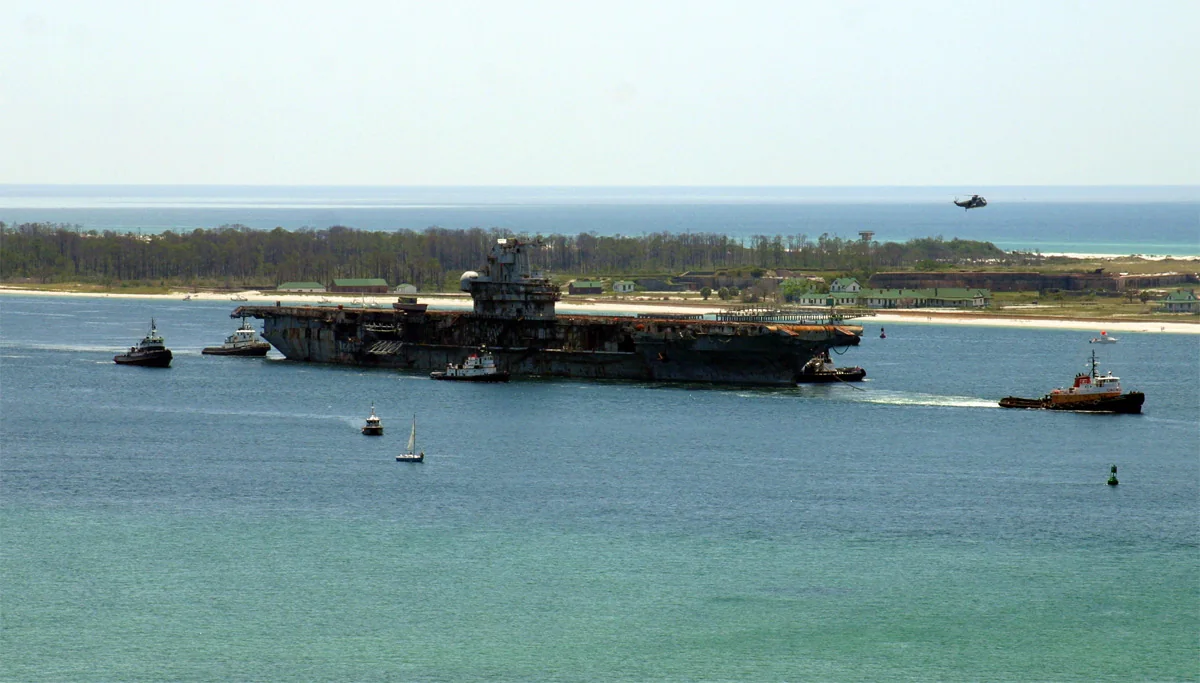
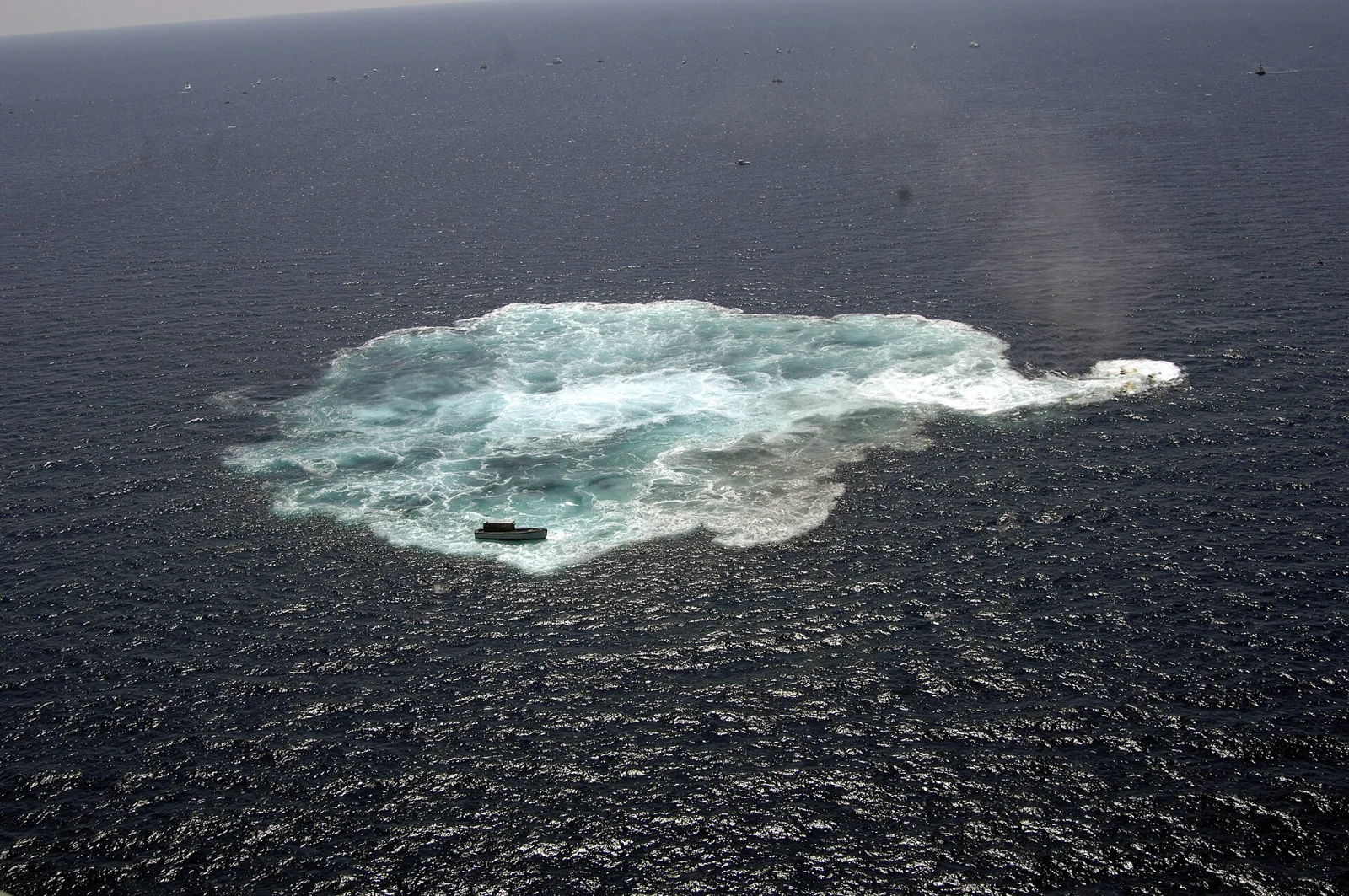
On 17 May 2006, the decommissioned USS Oriskany went to the bottom of the Gulf of Mexico. The sinking was deliberate. After a quarter-century of naval service and decades of remembrance by her crew, the carrier was prepared to become an artificial reef off the Florida Panhandle. The ship’s new role is striking, but it is also more complicated than the familiar phrase “ship turned reef” suggests.
Florida’s Fish and Wildlife Conservation Commission says the carrier sits about 22.5 nautical miles southeast of Pensacola Pass, on a seabed roughly 212 feet deep. The project brought together the U.S. Navy, the state and Escambia County. At 911 feet long, the former warship was an unusually large structure to place in coastal waters. Its size gives divers a dramatic landmark, while its steel surfaces offer places that marine organisms may colonize over time.
A working ship before a dive site
The Oriskany was commissioned in 1950 and decommissioned in September 1976. According to the Naval History and Heritage Command, she operated in several theaters during her career, including service connected with the Korean and Vietnam wars. The ship was a workplace and a home for thousands of sailors. Its story cannot be reduced to either a warship silhouette or a recreational destination.
Before the reefing, the vessel required preparation and environmental review. A Navy fact sheet describes work to ready the ship for its final use. That preparation matters: putting a large vessel on the seabed is not the same as abandoning it there. Planners must consider contaminants, stability, navigation and the long-term behavior of the structure.
What a reef can—and cannot—do
An artificial reef provides hard surfaces and shelter in a place where those features may be scarce. NOAA explains that reef structures can attract fishes and invertebrates and can support recreation and local economies. But NOAA’s overview is not a promise that every structure will create new marine life. Species, location, water conditions and management all shape the result.
The Oriskany is a useful reminder that ecological claims need observation, not just an impressive photograph. A diver may see fish gathered around the hull, yet that sight alone cannot show whether a population has grown or moved from somewhere else. The continuing questions belong to scientists and resource managers: which organisms settle, how the structure changes, and whether nearby habitats benefit or face new pressure.
A powerful site with real limits
The ship is not a casual dive. The FWC’s site guidance warns about depth, distance from shore and currents, and urges divers to match the trip to their training, equipment and experience. It also advises against entering the ship because the condition of its interior is uncertain. Conditions can change as storms, sediment movement and corrosion alter the wreck.
Those cautions are part of the Oriskany’s story, not a footnote to it. A landmark can inspire curiosity while still demanding humility. For readers who will never dive the wreck, the site offers another way to think about maritime heritage: a ship can leave the surface, remain present in the lives of those who served aboard, and become part of a new, carefully monitored marine landscape.
The “Mighty O” now has two overlapping histories. One lives in photographs, logs and memories. The other continues beneath the Gulf. A responsible account should make room for both.